
Food in Suzhou and Hangzhou
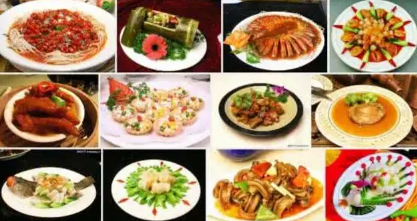
Every country and region in the world has its own traditional food culture. China's food culture is particularly rich and ancient. Nanjing, located in the middle reaches of the Yangtze River, is rich in natural resources, providing its people with abundant ingredients. Therefore, it also boasts a prosperous food culture. Today, let's take a look back at the history of Nanjing's food culture. The origin of your favorite dish... Nanjing cuisine is famous for its Jing-Su cuisine and halal cuisine. Nanjing cuisine is called Jing-Su Grand Cuisine, also known as Jing-Su cuisine or Jinling cuisine. The chefs refer to themselves as the "Jing-Su Gang," and it is one of the four major representative cuisines of Jiangsu cuisine.
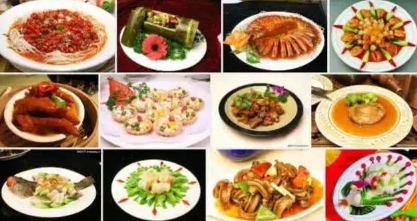
Jinling cuisine refers to the local flavor centered in Nanjing and extending to Jiujiang, Jiangxi Province. Originating in the pre-Qin period, Jinling cuisine gained fame during the Sui and Tang dynasties and became a distinct style during the Ming and Qing dynasties. Jinling cuisine primarily uses aquatic products, emphasizing freshness, meticulous knife skills, and skillful use of cooking methods such as stewing, braising, roasting, and simmering. The flavors are mild, fresh, fragrant, tender, and crispy. The dishes are delicate, exquisite, and elegant. Jinling cuisine emphasizes knife skills, mastery of cooking techniques, rich variations in cooking methods, and a flavor profile suitable for both northern and southern palates.
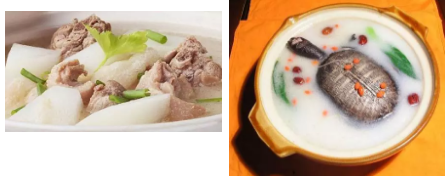
The famous poet Qu Yuan's work "Chu Ci" extensively records the characteristics of Wu and Chu cuisine, including beef tendon, barbecued lamb, stewed soft-shelled turtle, braised turtle, boiled swan, and braised duck. After Sun Quan established his capital in Jianye during the Three Kingdoms period, the social and economic development was rapid. As the largest commercial port in the country, Jinling (Nanjing) was filled with wealthy merchants who "wore pearls and jade," and the banks of the Qinhuai River were filled with the aroma of cooking and fine wine.
During the Northern and Southern Dynasties, Yu Cong of the Southern Qi Dynasty, a representative of the Six Dynasties' imperial chefs, was skilled in seasoning, and his dishes were so delicious that they surpassed the food prepared by the imperial chefs.
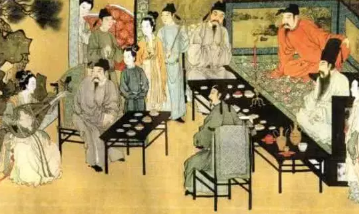
The painting "Han Xizai's Night Banquet" records a true depiction of a family banquet in Jinling at that time.
During the Tang and Song Dynasties, the catering industry was booming. Du Mu's poem "Mooring at Qinhuai" contains the line "Smoke shrouds the cold water, moonlight veils the scene, mooring at Qinhuai near a wine shop." This indicates that there were not only bustling markets during the day but also night markets and restaurants. During the Ming and Qing Dynasties, the food and beverage industry in Jiangning flourished. In August of the 27th year of the Hongwu reign of the Ming Dynasty, 15 new restaurants were built in Nanjing, demonstrating the prosperity of the catering market. According to historical records, the "Jing-Su cuisine" (京苏大菜) already existed in Nanjing around the Qing Dynasty. "Jing" refers to Nanjing as the capital of the Six Dynasties and the early Ming Dynasty; "Su" refers to Nanjing as the capital of Jiangsu Province during the Qing Dynasty. "Grand cuisine" describes the exquisite, elegant, magnificent, and generous nature of Nanjing cuisine. It was the abundant produce of the land of fish and rice from north to south of the Yangtze River, the exchange of trade via water and land transportation, the rich cultural heritage, and the refined folk customs that nurtured Nanjing's culinary culture.
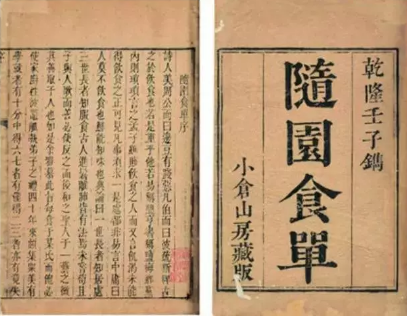
Yuan Mei, a talented scholar from Jiangnan during the Qing Dynasty, wrote a culinary masterpiece, *Suiyuan Shidan*, in Xiaocang Mountain, Nanjing. Published in 1792 (the 57th year of the Qianlong Emperor's reign), the book was based on the famous dishes of Beijing and Suzhou. Cao Xueqin further provided compelling evidence for the national prominence of Beijing and Suzhou cuisine through his descriptions of famous dishes and banquets in his masterpiece *Dream of the Red Chamber*.
During the Republican era, Nanjing-style restaurants clustered around the Confucius Temple area. Restaurants like Diyi Chun, Haidong Chun, Gonghe Chun, Lao Wanquan, Changsong Donghao, Jiabin Lou, Dajicheng, Lao Baoxin, and Jinling Chun all advertised themselves as serving "Beijing-Suzhou cuisine" to attract customers and distinguish themselves from other regional dishes. Local Nanjing chefs referred to themselves as belonging to the "Beijing-Suzhou school." Traditional famous dishes of Beijing-Suzhou cuisine include braised pork in a clay pot, stewed raw pork, assorted vegetarian dishes, stewed vegetable kernels, eight-treasure pine nut, pine nut smoked meat, and flat, large pork floss. Among them, dishes with a history of over 600 years include steamed shad, crispy crucian carp, phoenix fish, and phoenix cabbage hearts; dishes with a history of 200 years include shredded tofu, sunflower dumplings, and ham stewed with yellow sprouts.
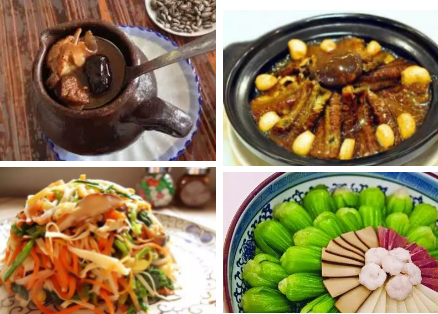
Potted meat, stewed raw pork, vegetarian assortment, stewed vegetable cores
Generally speaking, the grand cuisine of the Republic of China era is the same as the grand cuisine of Beijing and Suzhou. The grand cuisine of the Republic of China era is mainly based on the local Beijing and Suzhou cuisine, supplemented by other cuisines, including Zhejiang, Shaoxing, Guangdong, Guangxi, Hunan, and incorporating some flavors popular in Nanjing during the Republic of China period, such as halal cuisine. Like other cuisines such as those from Beijing and Suzhou, the dishes of the Republic of China era share a common characteristic: exquisite ingredients, meticulous craftsmanship, and time-consuming preparation. Even the table setting, the order in which dishes are served, and the service skills of the waiters are governed by specific rules. After liberation, restaurants such as Shao Fuxing (now Jiangsu Restaurant), Ma Xiangxing, Hualeyuan, Liuhuachun, Lvliuju, and Yongheyuan also introduced modern Beijing-Suzhou cuisine, such as: golden "Osmanthus Shrimp Cakes", doll-like "Double-Tail Shrimp Trays", exquisite "Apple Chicken", bright "Orchid Meat Rolls", elegant "Colorful Fish Clips", refreshing "Piao'er Duck Tongue", "Fire-Fried Bean Curd" with white lotus leaves inlaid with jade, "Clear Stewed Chicken" in a crispy soup bowl, and "Crab Roe Braised Cabbage" with fresh and tender meat.
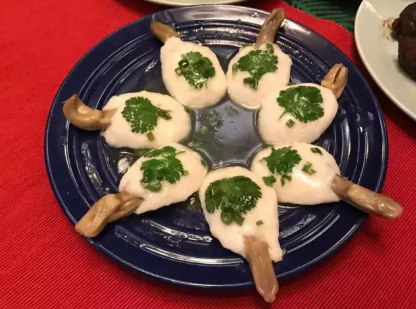
Melting-in-your-mouth duck tongue
Historically, Beijing and Suzhou cuisine consisted of official cuisine, market cuisine, folk cuisine, halal cuisine, vegetarian cuisine, and boat cuisine. Its characteristics include meticulous ingredient selection, refined preparation, emphasis on knife skills, preservation of original flavors, attention to seasonality, saltiness without blandness, blandness without thinness, spiciness without intensity, richness without greasiness, tenderness that falls off the bone without losing its shape, and smoothness and crispness without losing its freshness.
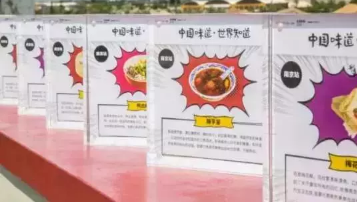
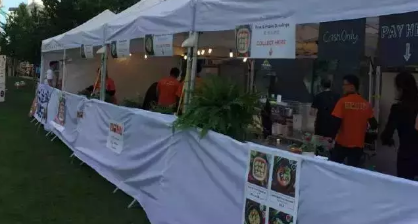
(Image courtesy of the "Nanjing Week" Organizing Committee)
In 2015, the Vanke Pavilion hosted Nanjing Day during "Nanjing Week" at the Milan Expo, showcasing various Nanjing delicacies in the "Chinese Flavors Known to the World" event;
Salted Duck
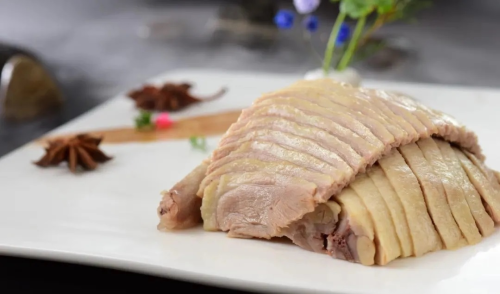
Nanjing (Nanjing) is renowned for its duck dishes, and among them, salted duck is undoubtedly one of the most popular. In the hearts of Nanjing people, salted duck has become an integral part of their lives, much like the chili oil on wontons—deeply intertwined with the DNA of Nanjing residents.
Vegetarian Assortment
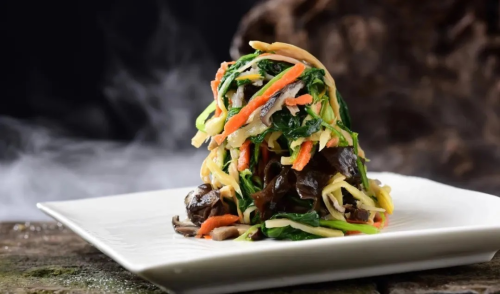
Vegetarian Assortment, also known as "Ten-Vegetable Dish," symbolizes perfection and is made by stir-frying various vegetables together.
According to the *Jinling Suishi Ji* (Chronicles of Jinling's Seasonal Customs), "On New Year's Eve, families would prepare ten dishes: pickled ginger and cucumber, carrots, daylily buds, wood ear mushrooms, winter bamboo shoots, white celery, soy sauce-soaked dried tofu, tofu skin, and gluten. These were finely shredded and stir-fried in oil, and were called the 'Ten Scenes.'" Phoenix Tail Shrimp ... Shrimp with shells on, once cooked, display a beautiful contrast of red and white, making it one of the world-renowned "Four Famous Dishes." Stewed Eel with Mud Mud Mud Stewed eel with mud mud has a history of over 300 years. The traditional method involves killing and deboning the eel, then pounding the meat with a wooden stick to loosen the texture, hence the name "stewed eel with mud mud." The famous scholar Professor Wu Bai highly praised it, once writing a poem: "If we talk about fragrant, crispy, and mellow flavor, Nanjing (Nanjing) is uniquely skilled in stewing eel with mud mud."
Eight Delicacies of Qinhuai
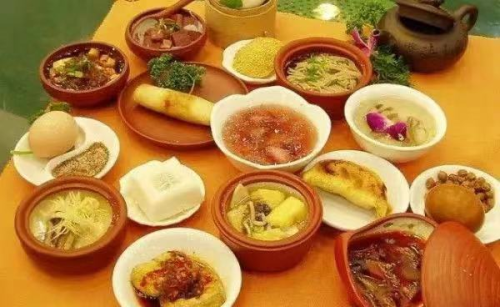
Nanjing snacks have a long history, a wide variety, and unique flavors, among which the "Eight Delicacies of Qinhuai" are particularly famous. These 16 snacks from 7 restaurants along the Qinhuai River offer a perfect balance of dry and wet, savory and sweet flavors.
Duck Blood Vermicelli Soup
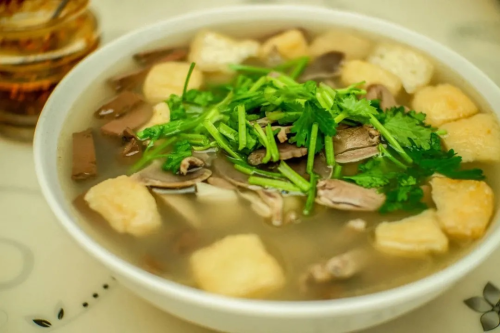
The best duck blood vermicelli soup is always the one from the shop downstairs from my house.
Smooth duck blood, firm duck gizzards, crisp and chewy duck intestines, savory duck liver, refreshing vermicelli, rich bean curd, chili oil, fragrant vinegar, and scallions sizzling with flavor…
Five-Spice Smoked Fish
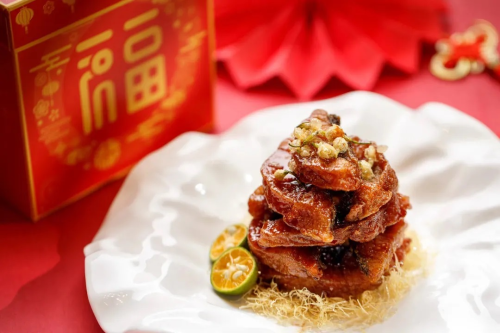
Every Chinese New Year, five-spice smoked fish is an indispensable dish on the dinner table of Nanjing families. The fish pieces, fried until slightly golden, are coated with an amber sheen in the sauce, crispy on the outside and tender on the inside, sweet but not greasy.
Three Herbs of Nanjing
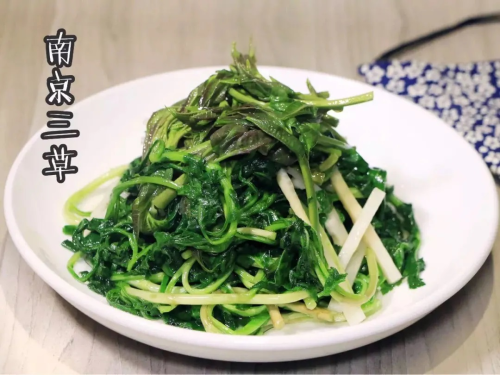
Wild vegetables are a staple of Nanjing cuisine. Located in an area where waterways and hills intersect, Nanjing boasts a rich variety of wild vegetables, with over 100 edible species. A Nanjing saying goes, "If you don't eat green vegetables for three days, your eyes will see stars." Various wild vegetables can be combined with other ingredients to create dishes that are vibrant green, fragrant, and refreshing, or they can stand alone as a dish.
Jinling Meatballs
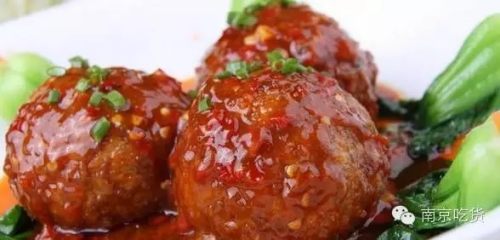
Image source: Nanjing Foodie
Jinling Meatballs are a traditional famous dish of Nanjing, belonging to the Beijing-Suzhou cuisine, and are one of the famous dishes of Nanjing cuisine. Made with carefully selected high-quality pork, and served on a base of soaked tendons, the meatballs are tender and fragrant, the tendons are soft and glutinous, and the broth is thick and rich in flavor.
A Family Reunion Dish
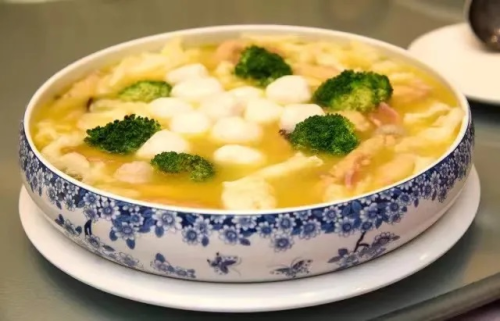
This dish is made by simmering sea cucumber, abalone, fish maw, fish balls, egg dumplings, and fresh vegetables together, resulting in a rich and delicious broth. The name "Family Reunion" symbolizes harmony and happiness.
The culinary masterpiece *Suiyuan Shidan*, written by the great Qing Dynasty scholar Yuan Mei in Xiaocangshan, Nanjing, is based on "Jinling cuisine." The meals of the "Twelve Beauties of Jinling" in Cao Xueqin's *Dream of the Red Chamber* further provide a record of "Jinling cuisine." Jinling cuisine is actually Nanjing cuisine, also known as Jing-Su cuisine.
The emphasis is on preserving the original flavor and highlighting the natural taste of the food.